New Delhi: For generations, competitive examinations have represented one of the most powerful instruments of social mobility in India. From securing admission to prestigious medical and engineering colleges to obtaining government employment and academic opportunities, examinations have traditionally been viewed as gateways to merit-based success. However, in recent years, a growing wave of examination paper leaks has cast a long shadow over this system, raising serious concerns about transparency, accountability, and institutional credibility.
What was once considered an occasional administrative lapse has evolved into a recurring national challenge. Examination leaks now affect millions of candidates across multiple states and sectors, leaving students, parents, educators, and policymakers grappling with a crisis that strikes at the heart of India’s educational framework.

A Growing National Concern
The frequency of paper leak incidents has increased significantly over the past decade. Major examinations conducted by both central and state authorities have repeatedly faced allegations of compromised question papers, irregularities, and organized cheating networks.
The impact extends far beyond a single examination cycle. Every cancellation, postponement, or re-examination affects lakhs of students who invest years of preparation, significant financial resources, and immense emotional energy in pursuit of their goals.
Recent years have witnessed multiple incidents involving recruitment examinations, teacher eligibility tests, university entrance examinations, and professional qualification assessments. These cases collectively suggest that the issue is not confined to one institution or state but reflects deeper structural vulnerabilities within the examination ecosystem.
The NEET-UG 2026 Controversy
Among the most significant recent developments was the controversy surrounding the National Eligibility cum Entrance Test (NEET-UG) 2026, one of the country’s largest and most competitive examinations.
The examination witnessed participation from more than 22 lakh candidates aspiring to secure admission to medical and dental colleges across India. Soon after the examination was conducted, allegations surfaced regarding the circulation of question material through unauthorized channels. Reports indicated that certain study materials and question compilations shared through digital platforms bore a striking resemblance to portions of the actual examination paper.
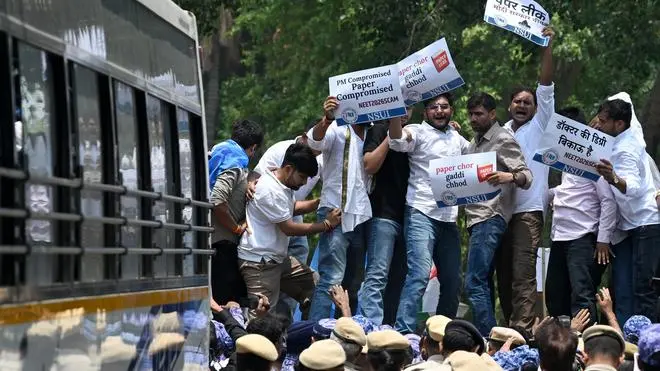
The allegations triggered widespread concern among students and parents, prompting authorities to launch investigations. Subsequently, the examination was cancelled, and investigative agencies were tasked with examining the circumstances surrounding the suspected leak.
The decision to conduct a re-examination under enhanced security arrangements reflected the seriousness of the issue. Additional surveillance measures, stricter monitoring protocols, and increased scrutiny of examination centres were implemented in an effort to restore confidence among candidates.
The episode became a defining moment in the national conversation on examination integrity, highlighting both the scale of the challenge and the urgency of reform.
State-Level Examinations Also Under Pressure
The problem is not limited to national entrance examinations. State-level recruitment and qualification tests have repeatedly encountered similar difficulties.
Teacher eligibility examinations, police recruitment tests, administrative service examinations, and various departmental recruitment processes have all faced allegations of leaks and irregularities. In several instances, authorities have been compelled to cancel examinations after evidence emerged that question papers had been accessed before the scheduled test.
These disruptions create widespread uncertainty among candidates. Recruitment timelines are delayed, government vacancies remain unfilled, and thousands of aspirants find themselves trapped in cycles of preparation and uncertainty.
In states where examinations attract several lakh applicants, a single leak can have consequences for an entire generation of job seekers.
Understanding the Root Causes
Experts argue that the paper leak crisis is the result of multiple interconnected factors rather than a single administrative weakness.
High-Stakes Competition
India’s competitive examination landscape is among the most intense in the world. Millions of candidates compete for a relatively limited number of seats and positions.
For example, medical entrance examinations attract far more applicants than the number of available seats. Similar competition exists in government recruitment examinations, where a single vacancy may attract hundreds of applicants.
This enormous pressure creates incentives for dishonest practices and fuels a black market for leaked examination materials.
Organized Criminal Networks
Investigations into several cases have revealed the involvement of organized networks operating across states. These groups allegedly exploit weaknesses in examination logistics, distribution systems, and administrative procedures.
Such networks often involve intermediaries, technology experts, and individuals with access to sensitive examination processes. Their operations are increasingly sophisticated and capable of exploiting digital communication channels to disseminate leaked information rapidly.
Technological Vulnerabilities
The widespread availability of encrypted messaging applications and social media platforms has transformed the nature of examination fraud.
Question papers or answer keys can now be shared instantly across thousands of users within minutes. Even small breaches can quickly escalate into large-scale compromises, making containment extremely difficult once information begins circulating online.
Insider Threats
Many investigations have pointed toward insider involvement as a critical factor. Individuals entrusted with examination-related responsibilities may misuse their access for financial gain or other motives.
Without rigorous background checks, accountability mechanisms, and real-time monitoring, sensitive examination materials remain vulnerable to unauthorized disclosure.
Administrative and Logistical Challenges
Conducting examinations for millions of candidates across thousands of centres is a complex undertaking. From printing and transportation to storage and distribution, every stage presents potential security risks.

As examination systems expand in scale, security infrastructure has not always evolved at the same pace, creating opportunities for exploitation.
The Human Cost
While discussions often focus on administrative failures and legal investigations, the greatest burden falls on students.
Many aspirants spend years preparing for highly competitive examinations. Families frequently invest substantial portions of their income in coaching, study materials, accommodation, and travel expenses.
When an examination is cancelled or postponed due to a leak, students experience not only financial losses but also emotional distress. Months or even years of preparation can be overshadowed by uncertainty and frustration.
Mental health professionals have increasingly highlighted the psychological impact of repeated examination controversies. Anxiety, stress, depression, and burnout have become common concerns among candidates navigating an environment marked by unpredictability.
For students from economically disadvantaged backgrounds, the consequences can be especially severe. Repeated examination cycles impose additional costs that many families struggle to bear.
Erosion of Trust in Institutions
Perhaps the most damaging consequence of recurring paper leaks is the gradual erosion of public trust.
Competitive examinations function effectively only when candidates believe that the process is fair. When leaks become frequent, perceptions of meritocracy begin to weaken.
Students may question whether hard work alone is sufficient for success. Parents may lose confidence in institutions responsible for conducting examinations. Employers and educational institutions may also face challenges in maintaining confidence in selection processes.
The broader implications extend beyond education. Trust in public institutions is a cornerstone of democratic governance, and repeated failures can have lasting social consequences.
Government Responses and Reform Efforts
Authorities at both central and state levels have introduced a range of measures aimed at addressing the crisis.
Investigations by specialized agencies, stricter monitoring protocols, enhanced surveillance systems, and tighter control over examination logistics have become increasingly common.
Several examination authorities have also begun exploring a transition toward computer-based testing systems. Digital examinations can reduce certain risks associated with printing and transporting physical question papers, though they introduce new cybersecurity challenges.
Legislative efforts aimed at imposing stricter penalties for examination fraud have also gained momentum. Policymakers increasingly recognize the need for deterrence through stronger legal frameworks and faster prosecution of offenders.
However, experts emphasize that punitive measures alone cannot solve the problem. Sustainable reform requires systemic improvements that address vulnerabilities at every stage of the examination process.
Building a More Secure Future
Addressing the paper leak crisis demands a comprehensive and forward-looking strategy.
Technology can play a significant role through encrypted question paper delivery systems, AI-driven monitoring, secure digital platforms, and advanced data analytics capable of detecting unusual patterns.
Equally important is institutional reform. Independent audits, transparent investigation procedures, stronger staff vetting mechanisms, and greater accountability can help reduce opportunities for malpractice.
Educational experts also advocate reducing excessive dependence on a handful of high-stakes examinations. Expanding educational opportunities, increasing seat availability, and creating multiple pathways for admission and recruitment could lessen the pressure that fuels examination-related misconduct.
Public confidence can only be restored when prevention becomes more effective than crisis management.
India’s paper leak crisis represents far more than a series of administrative failures. It is a challenge that affects the aspirations, opportunities, and futures of millions of young people.
The repeated disruption of examinations has exposed vulnerabilities within systems that are meant to reward merit and hard work. While investigations, cancellations, and re-examinations may address immediate concerns, lasting solutions require deeper structural reforms.
The credibility of India’s educational and recruitment institutions depends on their ability to guarantee fairness, transparency, and security. As the nation continues to invest in its demographic dividend and knowledge economy, ensuring the integrity of examinations is no longer merely an administrative priority—it is a national imperative.
The hopes of millions of students rest on the promise that effort, talent, and dedication will be rewarded fairly. Rebuilding that promise is essential for the future of India’s education system and for the trust that underpins it.


 ---------------------------------------------------------------------------------------------------